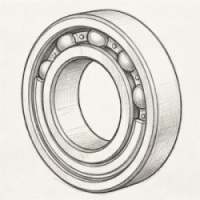
In the process of mechanical component selection, engineers and procurement specialists often find the wide variety of spherical plain bearings difficult to differentiate. However, the underlying classification logic is highly structured. By understanding the five core classification methods, the bearing selection process becomes significantly more efficient and technically accurate.
I. Classification by Load Direction and Contact Angle
This is the most fundamental and critical classification method because it directly relates to load transmission and mechanical performance.
1. Radial Spherical Plain Bearings
Primarily bears radial loads (contact angle 0°~30°)
Based on the contact angle, they are further divided into: l Radial contact radial spherical plain bearings (0°): Primarily bear radial loads, but can also bear a small amount of axial load; l Angular contact radial spherical plain bearings (0°~30°): Can bear combined radial and axial loads simultaneously.
2. Thrust Spherical Plain Bearings
Thrust spherical plain bearings are intended primarily for axial load applications, with contact angles ranging from 30 to 90°.
This can also be further subdivided into:
• Axial contact thrust spherical plain bearings (90°) specifically designed to withstand pure axial loads.
• Angular contact thrust spherical plain bearings (30°~90°) primarily withstand axial loads, but can also withstand a certain amount of radial load. Note: The radial load cannot exceed 0.5 times the axial load.
II. Classification by Outer Ring Structure
The structural configuration of the outer ring determines installation characteristics, assembly flexibility, and load distribution behavior.
Common Structural Types:
Integral (solid) outer ring spherical plain bearings
Single-slit outer ring spherical plain bearings
Double-slit (split outer ring) spherical plain bearings
Two-piece (double-half outer ring) spherical plain bearings
III. Classification by Whether or Not a Rod End is Included
This classification is very common in engineering applications:
* General-purpose spherical plain bearings (used independently)
* Rod end spherical plain bearings (directly mounted on the end of a rod) Commonly used in linkage mechanisms, hydraulic systems, etc.
IV. Classification by Lubrication Method
This directly affects usage and maintenance costs:
* Lubricated spherical plain bearings (requires regular lubrication)
* Self-lubricating spherical plain bearings (maintenance-free or low-maintenance)
More and more equipment is beginning to favor self-lubricating structures.
V. Comprehensive Classification
In practical applications, spherical plain bearings are typically classified by comprehensively considering load, structure, and application as follows:
· Radial spherical plain bearings
· Angular contact spherical plain bearings
· Thrust spherical plain bearings
· Rod end spherical plain bearings
VI. Technical Conclusion for Bearing Selection
Selection errors involving spherical plain bearings are often caused not by insufficient product knowledge, but by an inadequate analysis of load direction and resultant force distribution.
The first step in any bearing selection procedure should always be:
Determine the primary load direction
Identify whether combined loads are present
If the fundamental load analysis is incorrect, subsequent decisions regarding bearing structure, material, or lubrication method will not ensure the required service life or operational reliability.