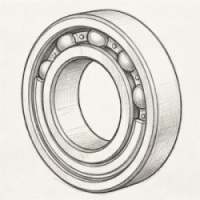
During bearing installation, the term“fit tolerance”is frequently encountered—such as clearance fit, transition fit, and interference fit. But how should the correct fit type be selected?
What Is Bearing Fit?
“Fit” refers to the relationship between the tolerance zones of a hole and a shaft that share the same basic size—in other words, the relative relationship between the bore and the shaft.
Clearance Fit:
When the algebraic difference between the hole size and the mating shaft size is positive, it is called a clearance. In this case, the hole is larger than the shaft. Whenever there is relative motion between two components, clearance must exist.
Interference Fit:
When the algebraic difference between the hole size and the mating shaft size is negative, it is called interference. In this case, the hole is smaller than the shaft. Due to the interference, no relative motion is allowed between the shaft and the hole, but certain torque and axial loads can be transmitted.
Transition Fit:
A transition fit means that either clearance or interference may occur during assembly. The tolerance zones of the hole and shaft overlap. It is mainly used in applications requiring high centering accuracy and coaxiality, allowing both precise positioning and ease of disassembly.
Before determining the fit type, it is necessary to understand the rotational and load conditions of the bearing rings, the bearing positioning arrangement, and installation requirements.
1. Determining Fit Based on Rotation and Load Conditions
Rotating Load
A rotating load occurs when the bearing ring rotates under a fixed load, or when the bearing ring is stationary while the load rotates. Oscillating loads (e.g., loads acting on connecting rod bearings) are also considered rotating loads. If a bearing ring installed with a clearance fit is subjected to a rotating load, relative movement may occur at the mating surface, leading to creep, fretting corrosion, and eventual wear. To prevent this, an appropriate interference fit must be applied between the bearing ring and its mating surface.
Stationary Load
A stationary load occurs when the bearing ring is stationary and the load direction is fixed, or when both rotate at the same speed. In this case, there is generally no relative movement, and thus no risk of fretting or wear. Therefore, an interference fit is not required.
Indeterminate Load Direction
This refers to variable or alternating loads, impact loads, as well as vibration or unbalanced loads in high-speed applications. Since the load direction cannot be precisely predicted, there is a risk of creep and wear. In such cases, interference fits should be used for both inner and outer rings, similar to rotating load conditions.
2. Determining Fit Based on Bearing Floating Condition
Bearing systems are typically designed as fixed–floating arrangements, with one fixed end and one floating end.
The purpose of the floating end is to accommodate thermal expansion and contraction of the shaft. If deep groove ball bearings, self-aligning ball bearings, or spherical roller bearings are used at the floating end, the outer ring must be able to move axially within the housing. Therefore, a clearance fit is required.
If the outer ring is not subjected to a stationary load, a clearance fit may cause housing wear. In such cases, protective measures should be applied to the seating surface, or bearings with internal axial displacement capability should be selected, such as:
Cylindrical roller bearings
Needle roller bearings
CARB bearings
When using these types, interference fits can be applied to both inner and outer rings.
3. Determining Fit Based on Installation Requirements
Bearings with clearance fits are easier to install and disassemble, making them preferable where frequent maintenance is required.
4. Adjusting Fit Based on Shaft and Housing Materials
In practical design, shaft and housing materials—and their structural forms—may vary. It is important to avoid deformation of the bearing rings caused by improper fit selection.
For example:
Bearings mounted in thin-walled housings or on hollow shafts should use tighter interference fits than those used with thick-walled housings or solid shafts.
Split housings generally recommend clearance fits. The tighter the fit, the higher the requirements for geometric tolerances of the bearing seat.
Non-steel or cast iron materials may require different fits due to differences in strength and thermal expansion coefficients.
5. Determining Fit Based on Equipment Accuracy Requirements
Precision or high-speed equipment is more sensitive to deflection and vibration. To minimize these effects, interference fits or transition fits are recommended.
6. Determining Fit Based on Temperature Effects
During operation, the temperature of the bearing rings is usually higher than that of the mating components.
For example:
Heat generated by friction may not dissipate quickly, causing expansion of the inner ring and loosening of the fit.
Bearing failures due to high temperatures are often accompanied by ring creep.
Friction from seals can also generate heat, loosening the inner ring fit.
External heat sources and heat flow may also affect the fit condition.
Therefore, when selecting bearing fits, it is essential to consider both steady-state and transient temperature differences between the bearing rings and their mating components.