In the world of precision engineering, the performance and lifespan of a rolling bearing depend heavily on how each individual component is manufactured. From inner and outer rings to rolling elements and cages, every step in the production process must meet strict quality standards.
This article provides a clear and practical overview of the manufacturing process of rolling bearing components, helping engineers, buyers, and technical professionals better understand how high-quality bearings are made.
1. Manufacturing Process of Inner and Outer Rings
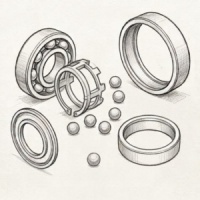
The inner and outer rings are the core structural components of a rolling bearing. Their dimensional accuracy and surface quality directly affect load capacity and rotation stability.
Typical production process:
Unannealed bar material → Forging → Annealing (or normalizing) → Turning → Heat treatment (quenching and tempering) → Grinding → Superfinishing → Final inspection → Rust prevention → Storage
Technical insights:
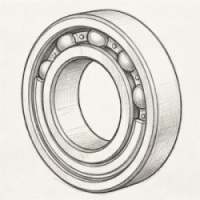
Forging improves the internal grain structure of the steel, enhancing strength and fatigue resistance. Heat treatment ensures the rings achieve the required hardness, while precision grinding and superfinishing reduce surface roughness and friction, which is essential for high-speed deep groove ball bearings.
2. Steel Ball Manufacturing Process
Steel balls are the rolling elements in ball bearings, and their roundness, surface finish, and hardness are critical to bearing performance.
Typical production process:
Bar or wire rod → Cold heading (ball blank forming) → Flash removal → Rough grinding → Heat treatment (quenching and tempering) → Hard grinding → Fine grinding → Lapping (superfinishing) → Final inspection and grading → Cleaning, rust prevention, packaging → Storage
Technical insights:
The lapping process is particularly important, as it ensures ultra-high precision in diameter and surface finish. High-quality steel balls contribute to reduced noise, lower vibration, and longer bearing service life.
3. Roller Manufacturing Process
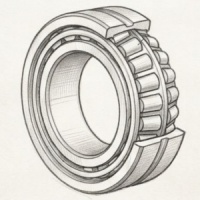
Rollers are used in cylindrical, tapered, and spherical roller bearings, where they carry heavier loads compared to balls.
Typical production process:
Bar or wire rod → Cold heading or turning → Flash removal → Soft grinding → Heat treatment (quenching and tempering) → Hard grinding → Sorting (removal of soft spots) → Outer diameter fine grinding → End face rough grinding → End face finish grinding → Outer diameter fine grinding → Final outer diameter grinding → (Superfinishing) → Final inspection and grouping → Rust prevention, packaging → Storage
Technical insights:
The geometry of rollers, including roundness and profile accuracy, is essential for load distribution. Multi-stage grinding ensures tight tolerances and optimal contact performance under heavy loads.
4. Stamped Cage Manufacturing Process
Stamped cages are widely used in high-speed and cost-sensitive bearing applications. They are typically made from steel sheet.
Typical production process:
Steel sheet → Strip cutting → Blanking → Stamping and forming → Shaping and finishing → Pickling or shot blasting or tumbling → Final inspection → Rust prevention, packaging → Storage
Technical insights:
Stamped cages are lightweight and suitable for high-speed rotation. Surface treatment processes such as shot blasting improve durability and remove residual stresses.
5. Machined (Solid) Cage Manufacturing Process
Machined cages are used in high-load or high-precision applications and are typically made from steel tubes or bars.
Typical production process:
Tube material → Turning of inner diameter, outer diameter, and end faces → Drilling (or broaching, boring) → Deburring → Pickling and final inspection → Oiling, packaging → Storage
Technical insights:
Compared to stamped cages, machined cages offer higher strength and better dimensional stability. They are commonly used in demanding industrial applications such as heavy machinery and high-performance equipment.
Conclusion
Understanding the manufacturing process of rolling bearing components is essential for evaluating bearing quality and selecting the right supplier. Each step—from raw material selection to heat treatment and superfinishing—plays a critical role in ensuring durability, precision, and reliability.
For buyers and engineers working with deep groove ball bearings and other rolling bearings, paying attention to these production details can help reduce failure rates, improve efficiency, and optimize long-term operating costs.
If you are sourcing bearings for industrial applications, always consider not just the price, but also the manufacturing standards and process control behind the product.