1. Structural Design and Working Principles of Spherical Plain Bearings
The human shoulder joint allows the arm to rotate 360 degrees, while the hip joint lets the leg swing freely in all directions. Without joints, bones would be nothing more than rigid sticks, incapable of executing complex movements.
Is there a bearing that functions like human joints, allowing connected components to swing and tilt freely?
Yes. It is called the Spherical Plain Bearing.
1.1 Spherical Contact & Self-Aligning Capability
The core secret of a spherical plain bearing lies within its geometry—the spherical surface.
Its inner ring has a spherical outer surface, and its outer ring features a corresponding spherical inner surface. Together, they form a sliding pair that swivels freely.
This design closely mirrors human anatomy: the humeral head of the shoulder joint is spherical, fitting snugly into the glenoid cavity. This spherical contact enables flexible rotation—forward, backward, sideways, or in circles.
Spherical plain bearings operate on the exact same principle. The spherical contact provides superior self-aligning capabilities, allowing the bearing to automatically compensate for shaft misalignment, mounting errors, or structural deflections during operation.
1.2 Performance Comparison: Spherical Plain Bearings vs. Rolling Bearings (Deep Groove Ball Bearings)
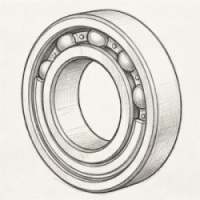
Eliminating Stress Concentration: Traditional deep groove ball bearings feature fixed cylindrical raceways. If shaft misalignment occurs, the rolling elements experience abnormal stress concentration, leading to accelerated wear or early failure. The spherical design of spherical plain bearings fundamentally resolves this issue.
High Load-Carrying Capacity: Furthermore, spherical plain bearings exhibit unique load-carrying characteristics—they can simultaneously withstand heavy radial and axial loads. Due to the large spherical contact area, load distribution is uniform, resulting in a load capacity far superior to rolling bearings of similar dimensions.
Thriving in Complex Conditions: Spherical plain bearings are also ideally suited for complex operating conditions such as swiveling, tilting, and low-speed rotation. Under these conditions, rolling elements in standard bearings are prone to skidding and fretting wear, whereas the sliding contact of spherical plain bearings offers greater stability and reliability.
2. Classification Standards of Spherical Plain Bearings (GB/T 304.1-2017)
2.1 By Load Direction and Contact Angle
According to the Chinese National Standard GB/T 304.1-2017, spherical plain bearings are primarily categorized by their nominal contact angle :
Radial Spherical Plain Bearings: Nominal contact angle τ ranges from 0° to 30°. Designed primarily for radial loads, though they can also support moderate axial loads.
Angular Contact Spherical Plain Bearings: Contact angle is intermediate, typically around 30°. Capable of supporting combined radial and significant axial loads simultaneously.
Thrust Spherical Plain Bearings: Nominal contact angle τ ranges from 30° to 90°. Specifically engineered to carry heavy unidirectional or bidirectional axial loads.
2.2 By Lubrication Method
Maintenance-Required (Lubricated) Type: Requires periodic re-greasing or oiling; suitable for clean and easily accessible maintenance environments.
Self-Lubricating Type: Incorporates self-lubricating PTFE or composite liners on the sliding surfaces; eliminates re-lubrication needs, perfect for hard-to-reach or contamination-sensitive applications.
2.3 By Structural Form
Solid Outer Ring Bearings: Single-piece outer ring offering high structural rigidity for heavy-duty applications.
Split Outer Ring Bearings: Outer ring split into two or more segments, bolted for easy mounting, clearance adjustment, or large-scale machinery.
Rod End Bearings: Integrates a spherical plain bearing with a rod end housing (featuring internal or external threads), widely used in linkage mechanisms.
3. Key Matching Industries and Typical Applications
Thanks to their high load capacity and self-aligning capability, spherical plain bearings serve as vital components across advanced industrial equipment:
Construction Machinery: Excavator bucket connections, crane boom joints, and wheel loader linkages—acting as the robust "skeleton" of heavy machinery.
Hydraulic & Water Conservancy Engineering: Dam gate hinges and hoist connecting mechanisms—ensuring long-term reliable service under submerged and humid conditions.
Robotics & Automation: Wrist and elbow joints of 6-axis industrial robots, welding/painting/handling arms—delivering high-frequency oscillation with micron-level precision.
4. About Luoyang Bearing Research Institute Co., Ltd. (ZYS)
Luoyang Bearing Research Institute Co., Ltd. (ZYS), established in 1958, is the sole national comprehensive research institute in China's bearing industry and a subsidiary of China National Machinery Industry Corporation (SINOMACH). ZYS specializes in the research, development, and manufacturing of high-precision, high-reliability bearings and related components for aerospace, rail transit, precision machine tools, engineering machinery, and wind energy applications.
In the field of spherical plain bearings and specialized custom bearing solutions, ZYS possesses comprehensive R&D capabilities, advanced testing facilities, and rigorous quality management systems to provide global customers with expert selection support and tailored solutions.
💡 Call-to-Action (CTA)
Need High-Performance Spherical Plain Bearings or Custom Solutions?
If you are looking for high-load, long-life spherical plain bearings for complex operating conditions, or require professional technical support and custom designs, feel free to contact us!