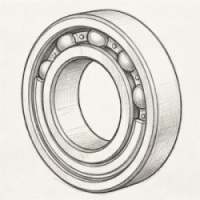
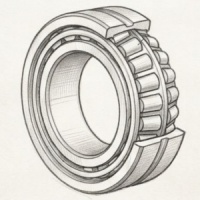
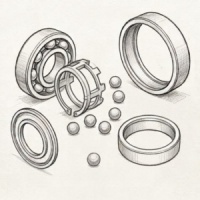
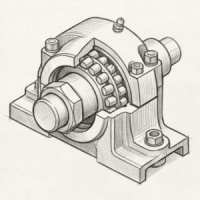
Bearings are among the most important components in electric motors. Their primary function is to support the rotating shaft, reduce friction during operation, and maintain accurate rotational performance.
Although bearings are designed for long-term operation, their service life is influenced by many factors, including operating load, rotational speed, lubrication condition, temperature, installation accuracy, and working environment.
For electric motors, bearing performance directly affects vibration level, noise, energy efficiency, and operational reliability. When bearing problems occur, they can lead to increased maintenance costs, unexpected downtime, and even secondary damage to other motor components.
Understanding the factors that influence electric motor bearing life helps engineers improve equipment reliability and reduce premature failures.
1. Bearing Fatigue and Service Life
For rolling bearings, the theoretical service life is mainly related to rolling contact fatigue.
During operation, repeated contact stress occurs between rolling elements and raceways. After a certain number of operating cycles, microscopic cracks may develop beneath the raceway surface and eventually lead to fatigue damage, commonly known as spalling.
Bearing manufacturers usually define bearing fatigue life using L10 life, which refers to the number of revolutions that 90% of a group of identical bearings can complete under the same operating conditions without fatigue failure.
However, in actual applications, many electric motor bearings fail before reaching their calculated fatigue life due to other factors, such as:
◆Poor lubrication
◆Contamination
◆Excessive temperature
◆Incorrect installation
◆Electrical damage
Therefore, improving bearing life requires more than simply selecting a bearing with a higher load rating.
2. Lubrication Condition
Lubrication is one of the most important factors affecting electric motor bearing performance.
A proper lubricant film separates the rolling elements and raceways, reducing friction and preventing direct metal-to-metal contact.
However, both insufficient and excessive lubrication can cause problems.
Insufficient Lubrication
When lubricant cannot provide adequate protection:
◆Friction increases
◆Operating temperature rises
◆Raceway damage may occur
◆Bearing noise and vibration increase
◆Excessive Lubrication
Too much grease can also be harmful, especially in high-speed motors.
Excess grease may cause:
◆Increased churning resistance
◆Higher temperature
◆Accelerated grease deterioration
Therefore, selecting the correct grease type and filling quantity according to speed, temperature, and operating conditions is essential.
For electric motors, commonly used lubricants should be selected according to:
◆Operating speed
◆Ambient temperature
◆Load conditions
◆Required service interval
3. Operating Temperature
Temperature has a significant influence on both bearings and lubricants.
High operating temperatures can accelerate:
◆Grease oxidation
◆Lubricant degradation
◆Seal aging
◆Loss of bearing clearance
In applications such as industrial motors, pumps, fans, and compressors, continuous operation at elevated temperatures requires bearings and lubricants with suitable temperature resistance.
It is also important to understand that excessive temperature is often a symptom rather than the root cause. Possible causes include:
◆Incorrect preload
◆Insufficient lubrication
◆Excessive load
◆Poor alignment
◆Inadequate cooling
4. Load and Speed Conditions
Bearing life is closely related to the actual operating load and speed of the motor.
Load
Both radial and axial loads affect bearing life.
Excessive loading increases contact stress between rolling elements and raceways, accelerating fatigue damage.
Common causes of excessive load include:
◆Improper belt tension
◆Rotor imbalance
◆Shaft misalignment
◆External mechanical forces
Speed
Higher rotational speed increases:
◆Centrifugal forces
◆Friction losses
◆Heat generation
High-speed motors require careful selection of:
◆Bearing type
◆Internal clearance
◆Lubrication method
◆Cage design
5. Installation Accuracy and Maintenance
Incorrect installation is one of the most common causes of premature bearing failure.
Typical installation problems include:
Excessive Interference Fit
Too much interference between the shaft and bearing inner ring may reduce internal clearance and increase operating temperature.
Insufficient Fit
Too loose a fit may cause:
◆Ring creep
◆Fretting corrosion
◆Vibration
◆Contamination During Assembly
Even small particles entering the bearing can create indentations on raceways and lead to early fatigue failure.
Proper installation should include:
◆Clean assembly conditions
◆Correct mounting tools
◆Accurate shaft and housing measurements
◆Verification of bearing clearance after installation
6. Electrical Damage in Motor Bearings
Unlike many mechanical applications, electric motor bearings face a unique failure mode: electrical erosion.
When voltage passes through the motor shaft, current may flow through the bearing. This can create:
◆Electrical pitting
◆Fluting marks on raceways
◆Lubricant degradation
◆Increased vibration and noise
Common solutions include:
◆Insulated bearings
◆Ceramic hybrid bearings
◆Shaft grounding systems
This issue is particularly important for variable frequency drive (VFD) motors, where high-frequency currents can increase the risk of bearing damage.
7. Bearing Design Factors
The bearing itself also influences service life.
Important design parameters include:
Bearing Type
◆Different applications require different bearing designs:
◆Deep groove ball bearings for general motor applications
◆Angular contact ball bearings for combined radial and axial loads
◆Cylindrical roller bearings for higher radial load capacity
Internal Clearance
Incorrect clearance can cause:
◆Excessive heat generation
◆Reduced load capacity
◆Increased vibration
Cage Design
The cage controls rolling element spacing and affects:
◆High-speed performance
◆Lubricant distribution
◆Operating stability
Conclusion
The service life of electric motor bearings is determined by a combination of factors rather than a single parameter. Bearing selection, lubrication, operating temperature, load conditions, installation accuracy, and electrical protection all play important roles.
In practical applications, premature bearing failures are often caused not by bearing manufacturing defects, but by unsuitable operating conditions or improper maintenance.
By selecting the correct bearing type, applying suitable lubrication, controlling operating temperature, and following proper installation procedures, engineers can significantly improve motor reliability and extend bearing service life.
For high-performance electric motors, a systematic approach to bearing selection and maintenance is essential to achieve stable operation and reduce unexpected downtime.